I've had some people asking me about how I've been setting up my Meta ads since the Andromeda update.
The platform has changed enough in the past couple of years that some of the old playbook — tight audience targeting, separate campaigns for every angle, manually tweaking bids — actually works against you now.
Here's how I'm approaching it since the update.
Tracking first
Before a single dollar goes toward ads, tracking has to be airtight.
The Meta Pixel alone isn't enough anymore. Since iOS 14, it misses 30–40% of purchase data. The fix is the Conversions API (CAPI), which sends data directly from your server to Meta. Shopify stores can enable this natively, and the target is 75%+ event match quality.
Five events need to fire in order: PageView → ViewContent → AddToCart → InitiateCheckout → Purchase. If you're running both Pixel and CAPI, enable event deduplication. Without it, Meta counts purchases twice, your reported ROAS looks inflated, and the algorithm gets confused.
Andromeda
In early 2026, Meta rolled out an AI system called Andromeda that changed how targeting works. It reads your creative — images, video, copy — and uses that to find the right people. Manual interest targeting doesn't just become unnecessary, it actively restricts the algorithm. The creative is the targeting now.
It also means Andromeda groups visually similar ads together and treats them as one. Ten ads that all look the same count as one ad with a wasted budget. The formats have to genuinely differ.
The 50 purchases rule
One campaign needs 50+ purchases per week to exit the learning phase and start optimizing reliably. During learning, results are unstable and costs run 20–50% higher.
Spreading budget across multiple campaigns means none of them hit that threshold. One strong campaign beats ten underfunded ones.
Campaign structure
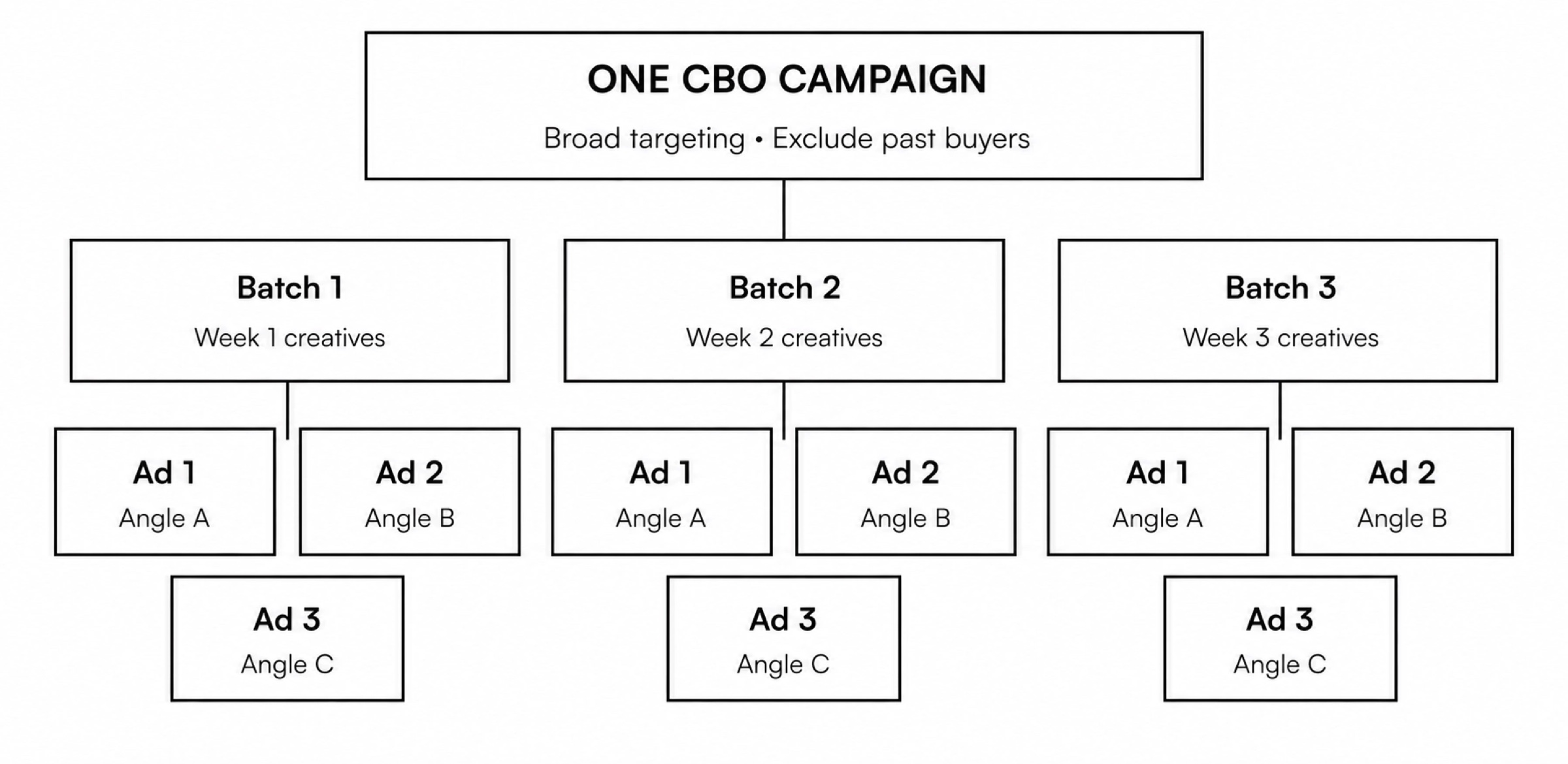
For spending under $5K/day, everything runs through a single CBO campaign with broad targeting and previous purchasers excluded.
Inside that campaign, creatives are organized into batches — each batch is its own ad set with three ads, each built around a different angle. After 3–5 days, the data tells you which batch is winning. Whatever's losing gets paused and replaced with new angles related to what the winner did well. The campaign stays live the entire time — you're not restarting anything, just swapping out what isn't working.
Once spend goes above $5K/day, the structure splits in two: a testing campaign for new batches, and a scaling campaign holding only proven winners. The testing campaign feeds the scaling one.
The creative batch system
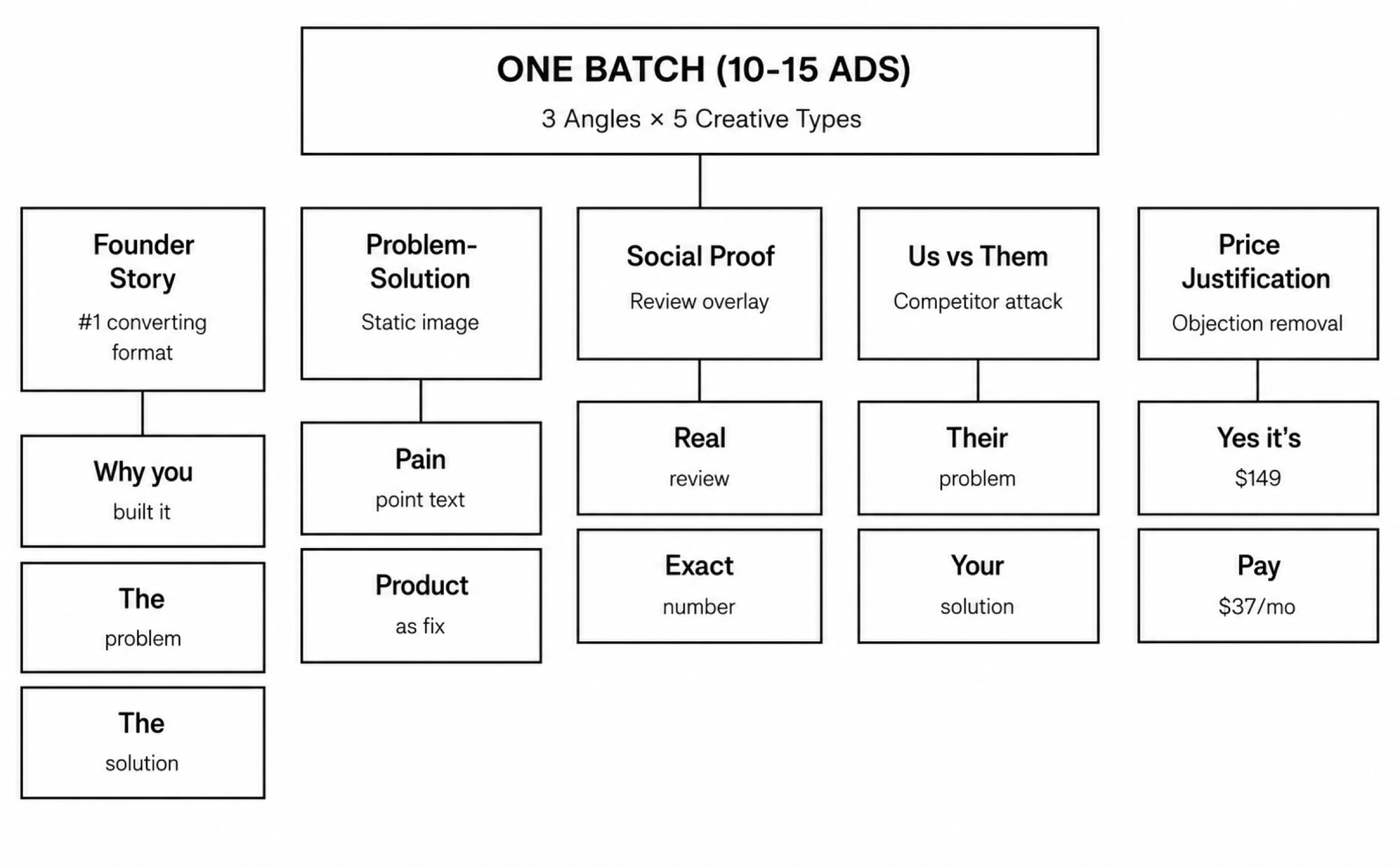
Each batch is 2–3 angles × 5 creative types = 10–15 ads.
The five formats: a founder story video (you talking to camera — why you built it, the problem, the solution), a problem-solution static image, a social proof overlay with a real review and a specific customer number, a competitor comparison, and a price justification ad that addresses the cost objection before they reach your landing page.
Inside each ad, I add up to five headline variations and five body copy variations. Meta auto-tests the combinations, so the testing surface is wide without a proportional increase in production work.
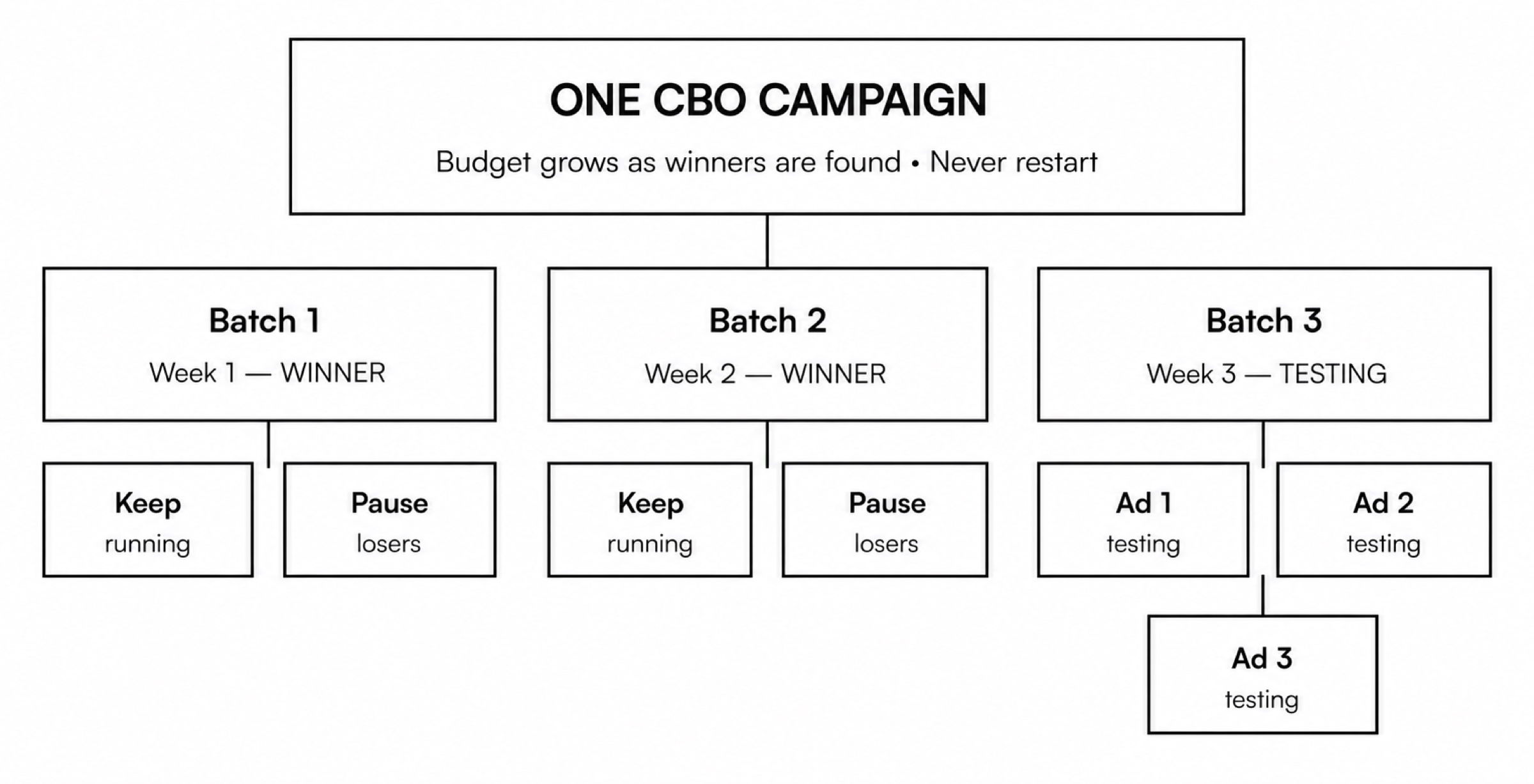
Each week, a new batch launches as a new ad set inside the same campaign. Winners keep running. Losers get cut.
Copy
The hook has under half a second to work. The first few words either stop the scroll or don't.
The copy formula I keep coming back to: open with empathy ("I get it"), acknowledge what they've already tried that failed, remove the shame around the problem, introduce the product with a specific point of difference, and close with a clean before/after contrast.
The other important thing is specificity. "Thousands of happy customers" does nothing. "2,847 customers gave this 5 stars" converts much more. Specific numbers build trust in a way that vague claims never will. Same goes for your store's pages.
Scaling
Never increase budget by more than 20–25% every 24–48 hours. Doubling overnight resets the learning phase. The three conditions before scaling anything: profitable above break-even for 5–7 consecutive days, out of the learning phase, and stable CPA.
What it is
One CBO campaign → batch creatives weekly → hit 50 purchases a week to exit learning → scale 20% at a time → never stop testing. Everything else is optimization on top of that.